A scientific and spiritual investigation into how a sacred symbol of well-being became the world’s most recognised emblem of hatred. One ancient sacred symbol. One modern political distortion.
For millennia, the Swastika has been one of Hinduism’s most sacred symbols of well-being and auspiciousness. In the 1920s, Adolf Hitler repurposed a tilted version of the symbol — calling it the Hakenkreuz (German: “hooked cross”) — as the emblem of the Nazi Party, forever linking it to genocide and racial terror. Despite clear physical differences, both symbols are now conflated in the public mind asthe Swastik. Spiritual research conducted by the Maharshi Adhyatma Vishwavidyalay (MAV), using scientific instruments and advanced sixth-sense perception, reveals that these two symbols differ not only in appearance and history but at the deepest level of subtle spiritual energy: one radiates positivity, the other emits profoundly negative vibrations.
Most people instantly recognise the Swastik (or Swastika), yet few fully understand the vast difference between its two most prominent versions (namely the Hindu Swastik and the Nazi distortion of the Swastik – Hakenkreuz).
To many in the West, all Swastiks look alike and evoke immediate revulsion — a reaction born from the horrific legacy of the Nazi regime. Yet to over a billion Hindus, Buddhists, and Jains across the world, the Swastik is and always has been a deeply sacred symbol invoked at every auspicious occasion: births, weddings, festivals, and the inauguration of homes and businesses.
This article seeks to bridge that gap.
Drawing on the spiritual research of the Maharshi Adhyatma Vishwavidyalay (MAV), we explore the historical, etymological, and above all spiritual differences between the original Hindu Swastik and the Nazi Hakenkreuz (Hakenkreuz being the German term used by Adolf Hitler himself, meaning “hooked cross”).
The very name Hakenkreuz — hooked cross — was Hitler’s own term for the symbol. The widespread use of ‘Swastik’ to describe it largely stems from a 90-year-old English translation of Mein Kampf that substituted ‘hooked cross’ with ‘Swastik’, further deepening the confusion between a sacred emblem of well-being and an emblem of hate.
The word Swastik is derived from the Sanskrit root swasti, which is itself composed of two elements:
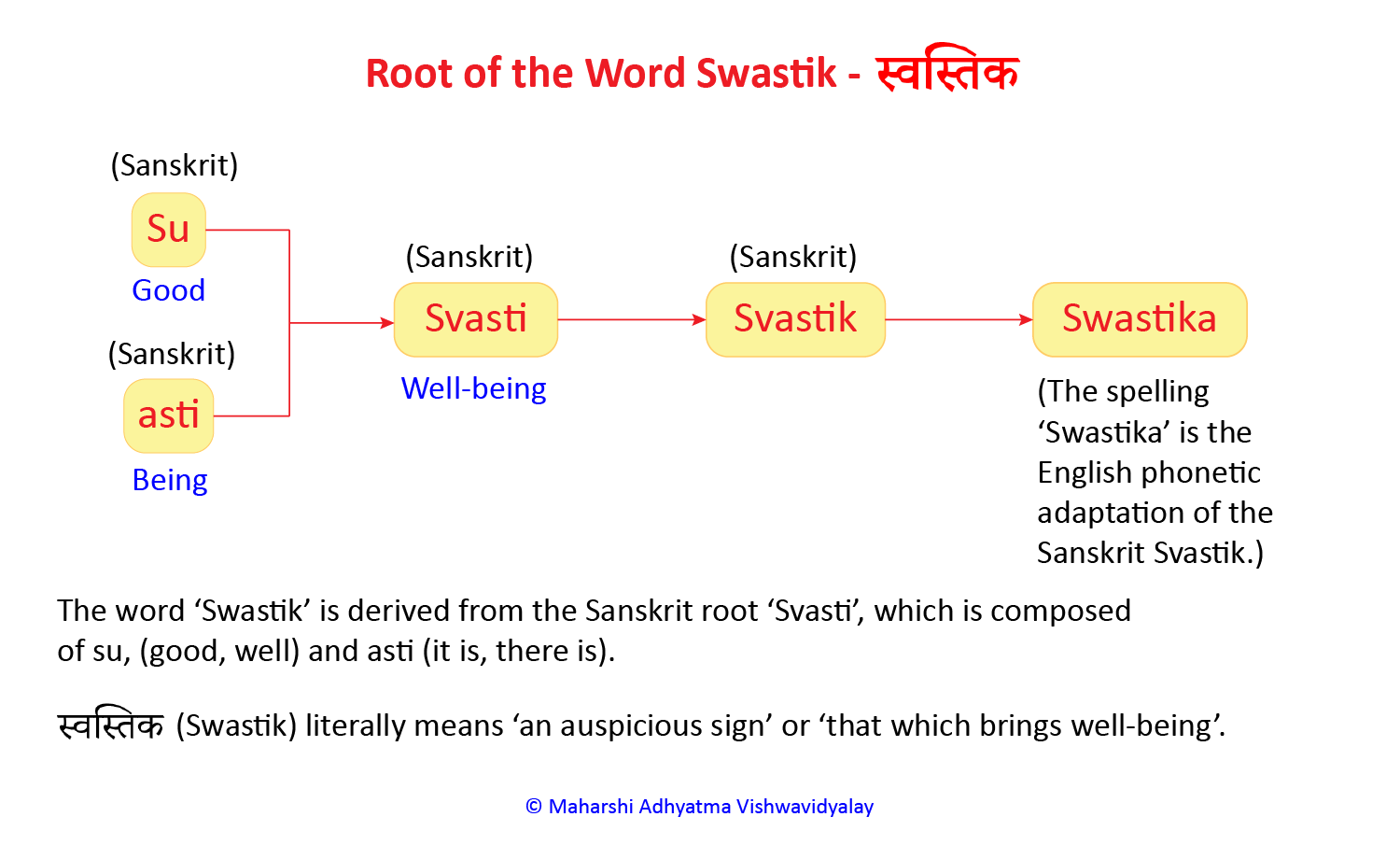
The term Svasti appears numerous times in the Vedas as a blessing that invokes Divine grace, peace, and welfare.
Long before it was adopted by any group in recent times — and centuries before the Nazi Party existed — versions of the Swastika appeared across nearly every ancient civilisation on Earth. Apart from the Indian subcontinent, historical evidence places it in the Roman Empire, ancient China, pre-Columbian Americas, and across Europe. It has been found carved into pottery, woven into textiles, and embedded in temple mosaics.
In each of these cultures, the symbol carried associations of life, the sun, power, and good fortune — never of hatred or racial ideology. Its widespread occurrence across unconnected civilisations suggests it taps into something universal in human perception of shape and meaning.
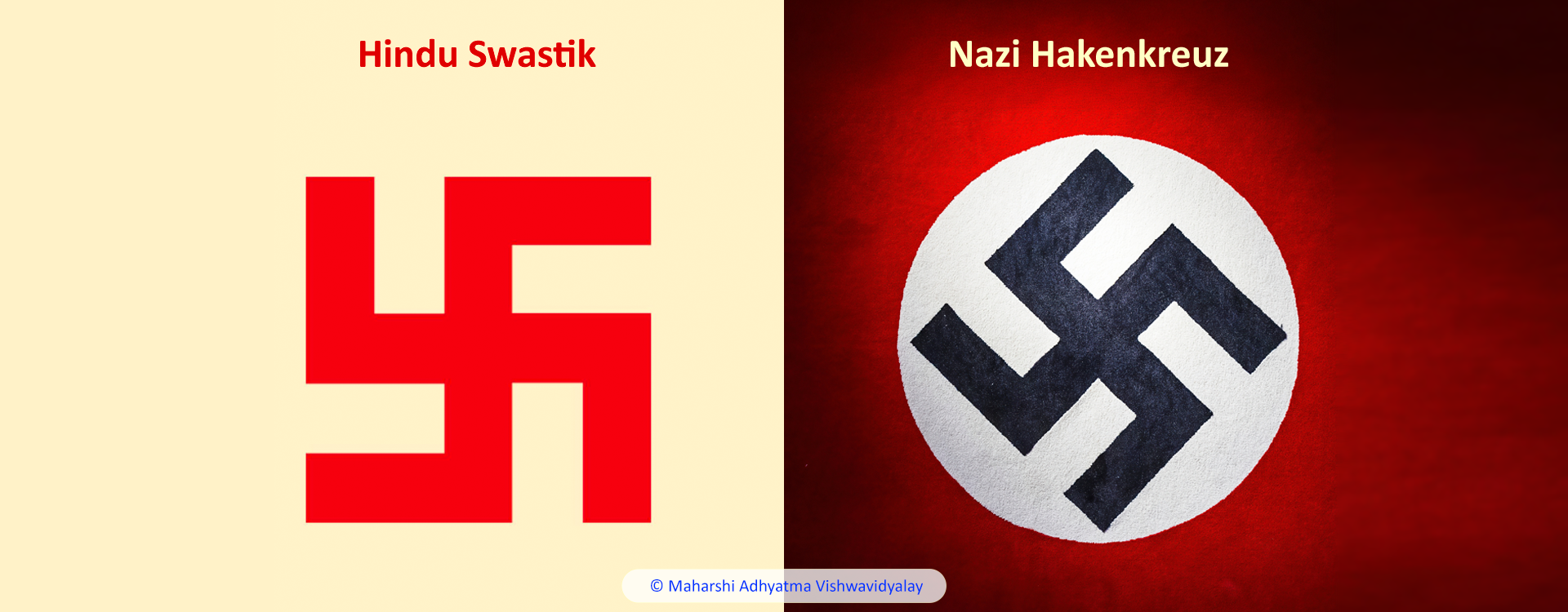
In the early 20th century, Adolf Hitler repurposed the Swastika as the central symbol of the Nazi Party, tilting it 45 degrees and placing it on a white disk against a red background. Hitler’s own account in Mein Kampf describes his meticulous personal design process for the flag. The resulting symbol — which he called the Hakenkreuz (hooked cross) — became the most recognisable icon of Nazi propaganda, appearing on flags, election posters, armbands, military badges, and official seals.
The Hakenkreuz was intended to elicit pride among so-called Aryans and to strike terror into Jews, Roma, and all others whom Nazi Germany declared its enemies. It is the emblem of the Holocaust, of genocide, and of one of history’s greatest crimes against humanity.

It is important to note that the word used in English — ‘Swastika’ — to describe the Nazi symbol largely stems from a 90-year-old English translation of Mein Kampf in which the German Hakenkreuz (“hooked cross”) was incorrectly substituted with ‘Swastika’. This translation choice has had an enormous cultural impact, cementing a confusion that has persisted for nearly a century and that has been deeply damaging to Hindu, Buddhist, and Jain communities worldwide.
Despite clear physical differences — the Hindu Swastika stands upright, while the Nazi Hakenkreuz is tilted 45 degrees — the two symbols have become so interlinked in the public consciousness that most people cannot distinguish between them. For many, all versions of the swastika represent the same thing: the banner of genocide and racial intolerance. The table below articulates the differences between the two symbols.
| Feature | Hindu Swastika (Swastik) | Nazi Hakenkreuz (Hooked Cross) |
|---|---|---|
| Orientation | Upright — arms horizontal and vertical | Tilted 45 degrees (diamond orientation) |
| Origin | Ancient India; used for thousands of years | Adopted by the Nazi Party in the 1920s |
| Meaning | Well-being, auspiciousness, good fortune | Racial supremacy, terror, genocide |
| Correct Name | Swastik (Sanskrit: svastika) | Hakenkreuz (German: “hooked cross”) |
| Colours (traditional) | Red on white/yellow; or gold/saffron | Black on white disk on red background |
| Context of use | Sacred spiritual symbol used in Festivals, temples, weddings, doorways | Nazi flags, military insignia, propaganda |
This conflation has caused enormous harm. Hindus displaying the Swastik at temples or homes during festivals are frequently misidentified as displaying a Nazi symbol. The result is that society has lost nearly a century of access to the positive spiritual benefits of the original Swastika.
Repurposing the Swastika as Hitler did is one of the spiritually worst rebranding exercises ever undertaken.

The Maharshi Adhyatma Vishwavidyalay (MAV) was founded by His Holiness Dr Jayant Athavale. The University specialises in researching how the spiritual dimension and subtle spiritual vibrations affect every aspect of our lives — including art, symbols, music, and architecture. The spiritual research team has over 40 years of accumulated experience.
The University has undertaken extensive research into religious and spiritual art, using a combination of advanced scientific instruments and the sixth-sense perception of trained seekers.
Key Principle: All objects — living and non-living, animate and inanimate — emit subtle vibrations. These vibrations can be positive, neutral, or negative, and they can be measured with appropriate instruments. The vibrations emitted by a symbol have a direct and measurable effect on anyone in its proximity or who wears it.
Before examining the Swastik and Hakenkreuz specifically, it is essential to understand some fundamental principles that MAV researchers have established through years of experimentation.
The primary instrument used in this research is the Universal Aura Scanner (UAS), developed by Dr Mannem Murthy, a former nuclear scientist from India. The UAS measures subtle energy — both positive and negative — and the aura (the subtle energy field) surrounding any object, living or non-living.

The UAS produces four types of readings for any object:
| Reading Code | Full Name | What It Indicates |
|---|---|---|
| IR | Infrared | A less intense form of negative energy detected |
| UV | Ultraviolet | A more intense form of negative energy detected |
| PA | Positive Aura | Positive subtle energy present |
| MA | Measured Aura | Total measured aura |
MAV researchers have taken over 15,000 readings of various objects over a 10-year period, establishing a reliable and consistent body of data.
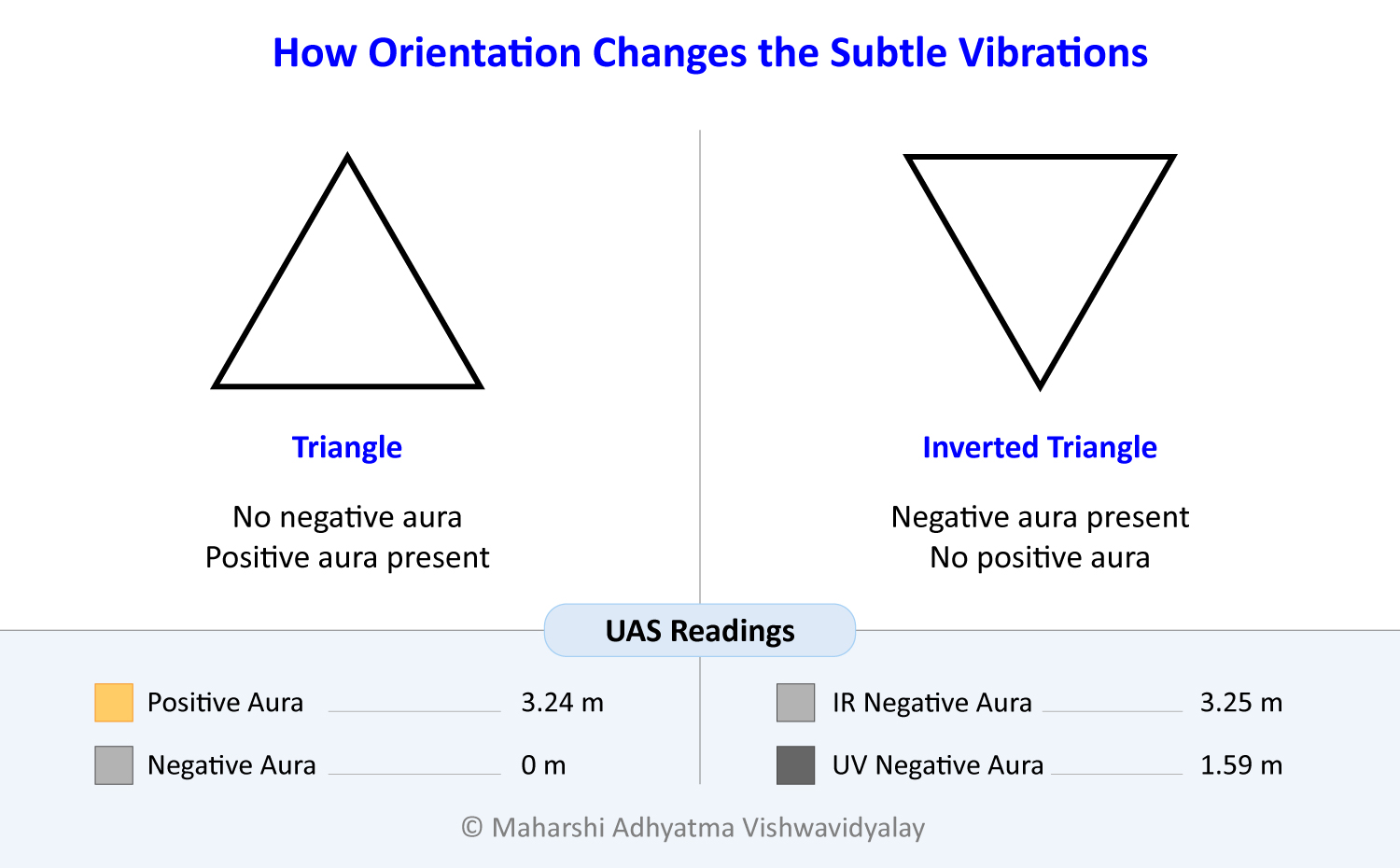
A key foundational finding of MAV’s research into shape and subtle energy is that the exact same shape, when inverted or rotated, can emit entirely different subtle vibrations.
As you can see below, there are two equilateral triangles – one straight and one inverted. Please note that even though they are exactly the same shape, the one placed on its base emits positive vibrations. The inverted one, however, emits negative vibrations,
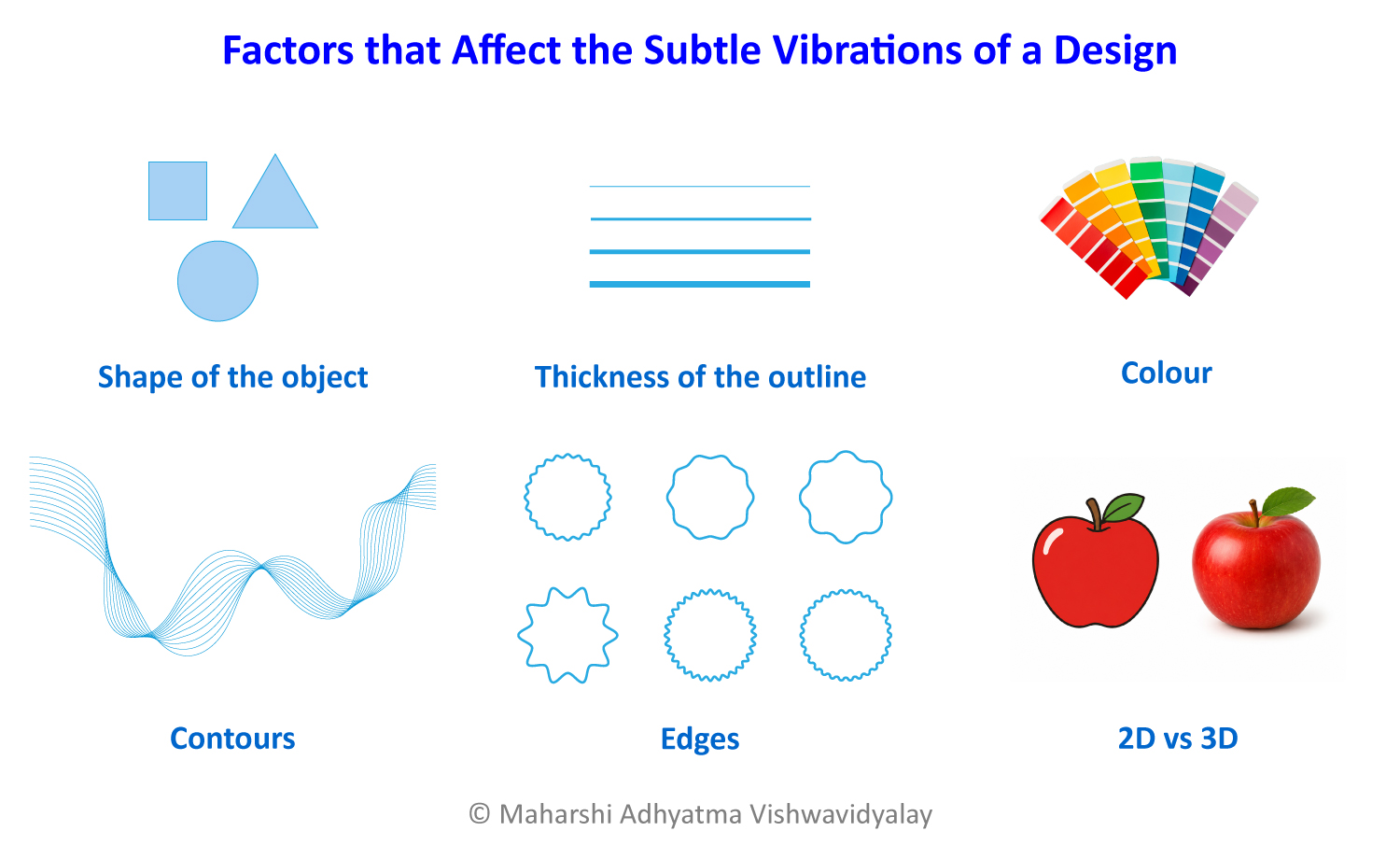
In addition to orientation, the following aspects of any object can alter its subtle vibrations:
MAV researchers used the UAS to measure four versions of the Swastika:
A — Original Hindu Swastik (upright, as used in Vedic tradition)
B — Inverted Swastik (mirror image)
C — Tilted Swastik (rotated 45°, plain)
D — Nazi Hakenkreuz in the Nazi Flag (tilted, black on white circle on red)
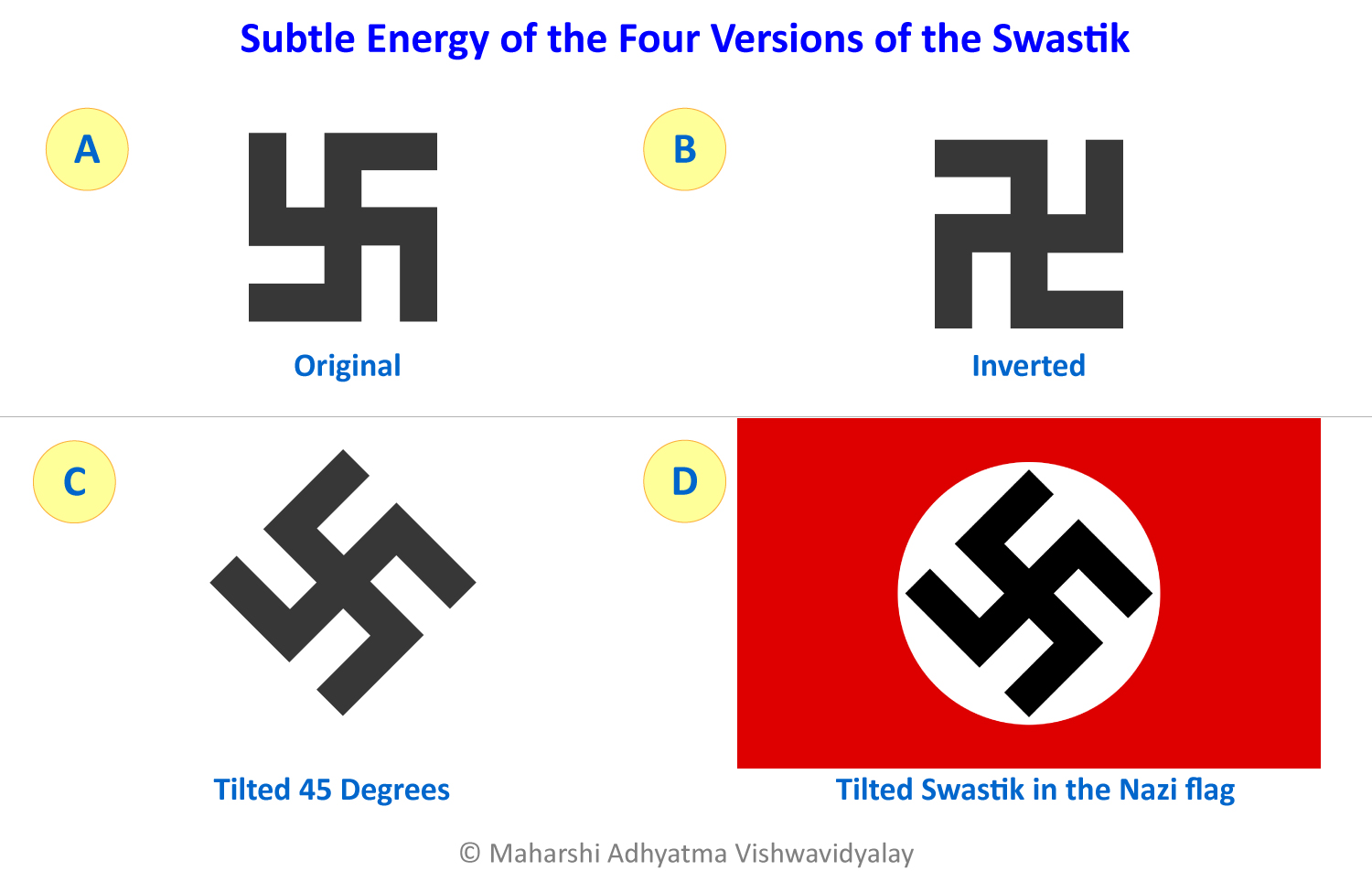
UAS Readings: Aura Measurements of the Four Swastika Versions (in metres)
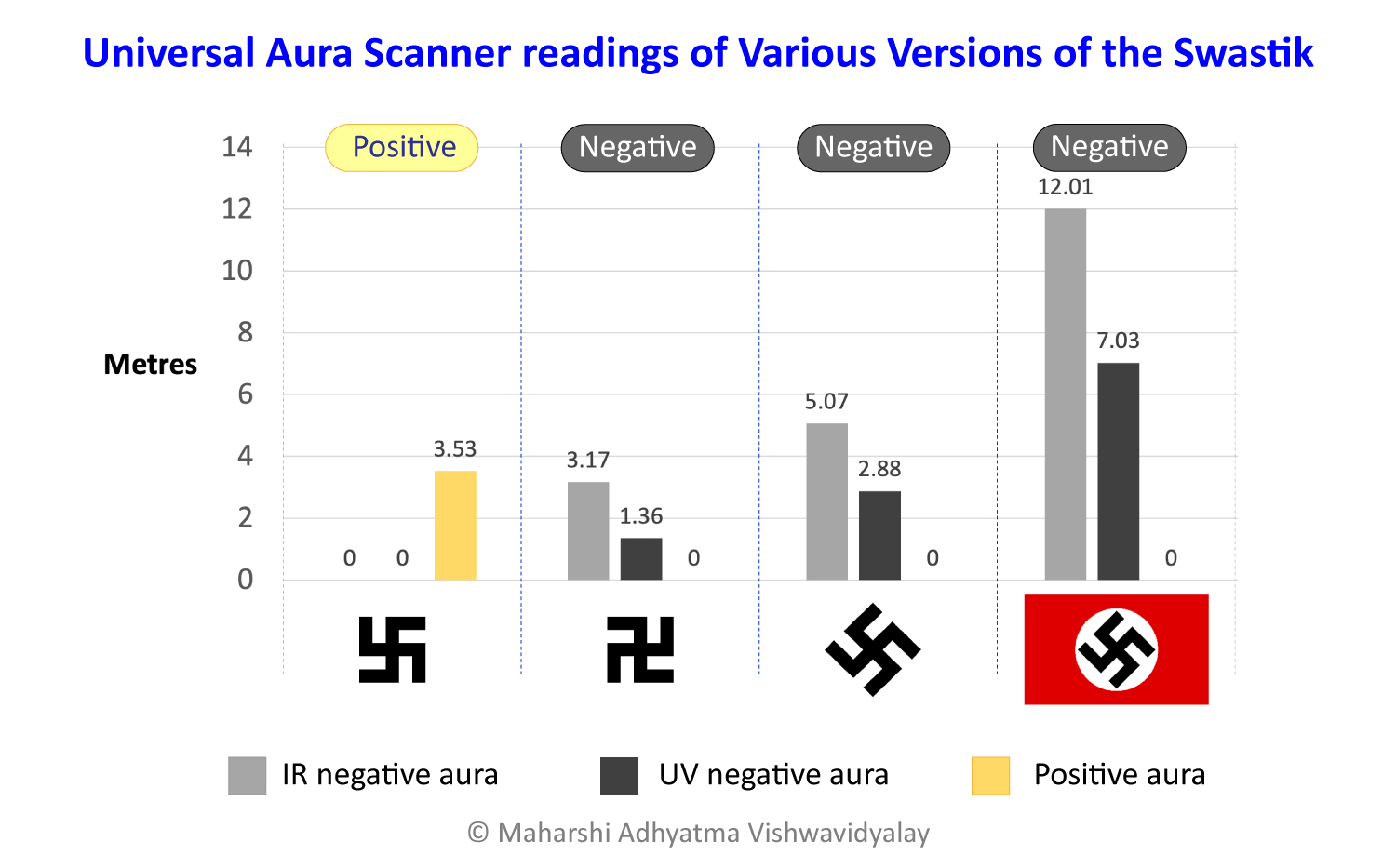
Snapshot of the Results of the Experiment
| Symbol | Result |
|---|---|
| Original Swastika | Positive aura |
| Inverted version | Negative aura |
| Tilted version | Stronger negative aura |
| Nazi Hakenkreuz | Most negative vibrations |
Key Finding: Only the original Hindu Swastik (A) emitted a positive aura. All other versions emitted negative auras. The Nazi Hakenkreuz in its full flag form (D) had an IR negative aura of 12.01 metres — making it the most negative symbol MAV has ever measured. Tilting the symbol increased its negativity; adding Hitler’s specific design elements further amplified the negativity and created what researchers describe as an illusory (Mayavi) attractive force.
Aura Research Foundation independently analysed these four Swastika variants using the Energy Hygiene Framework. Their frequency-domain measurements similarly found the original Hindu Swastik to differ fundamentally from the tilted, inverted and Nazi variants. Readers interested in the underlying frequency analysis are referred to the companion paper by Aura Research Foundation.
In addition to instrument-based measurements, MAV uses ‘subtle pictures’ — drawings made by trained seekers with advanced sixth-sense perception — to analyse the spiritual dynamics of objects and phenomena. These seekers can visually perceive the subtle energy around objects and draw what they sense. These drawings are akin to spiritual X-rays, providing the average person with an unparalleled glimpse into the spiritual dimension.
Her Holiness Mrs Yoya Vallee, a Saint from SSRF and gifted seeker-artist, produced subtle pictures of the original Swastika, the titled Swastik and the Nazi Hakenkreuz (Nazi version of the Swastika). The contrast is striking.
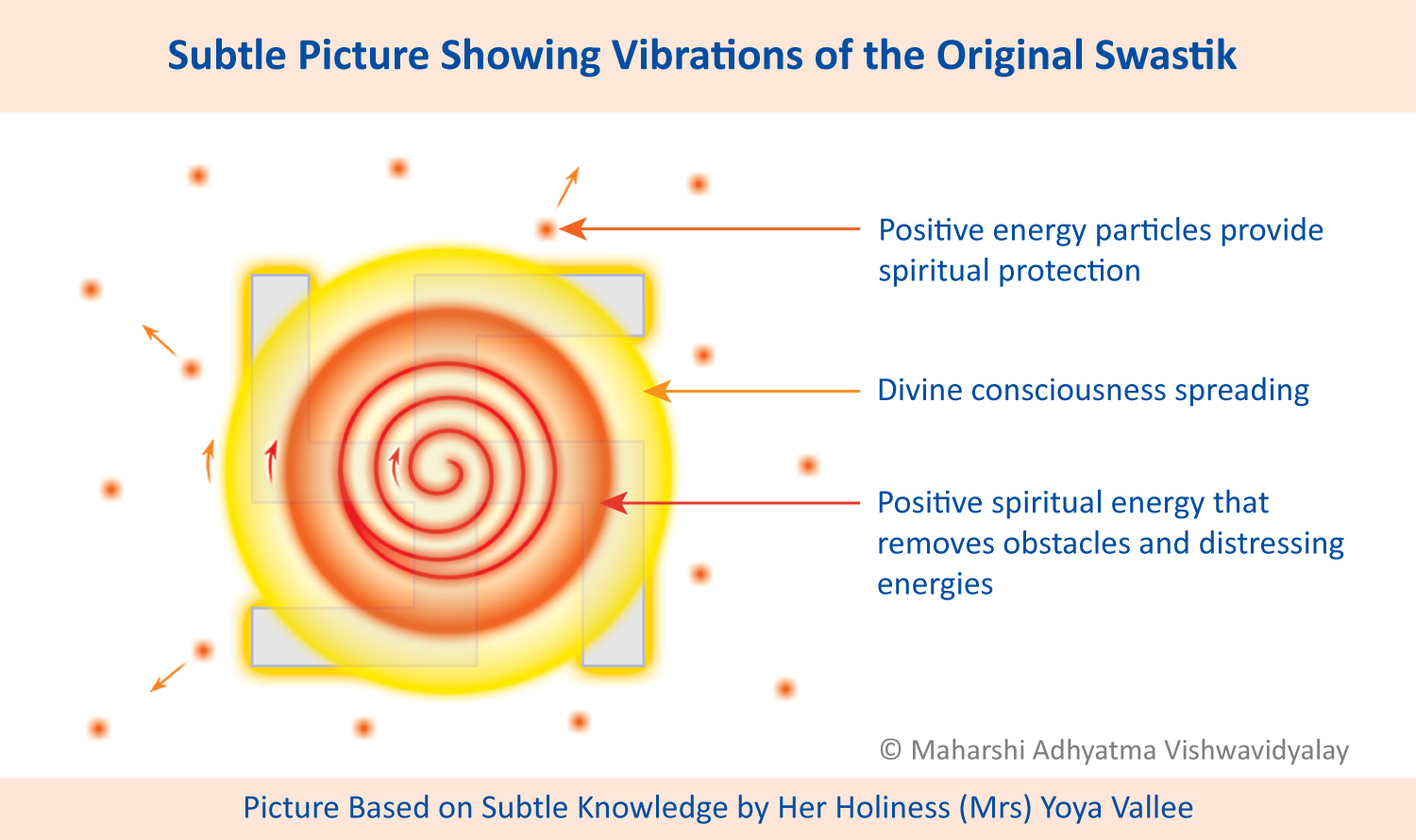
This is a subtle picture of the original Swastika, and you can see the positive vibrations it attracts and emits. And this is the reason why it is known as an auspicious symbol.
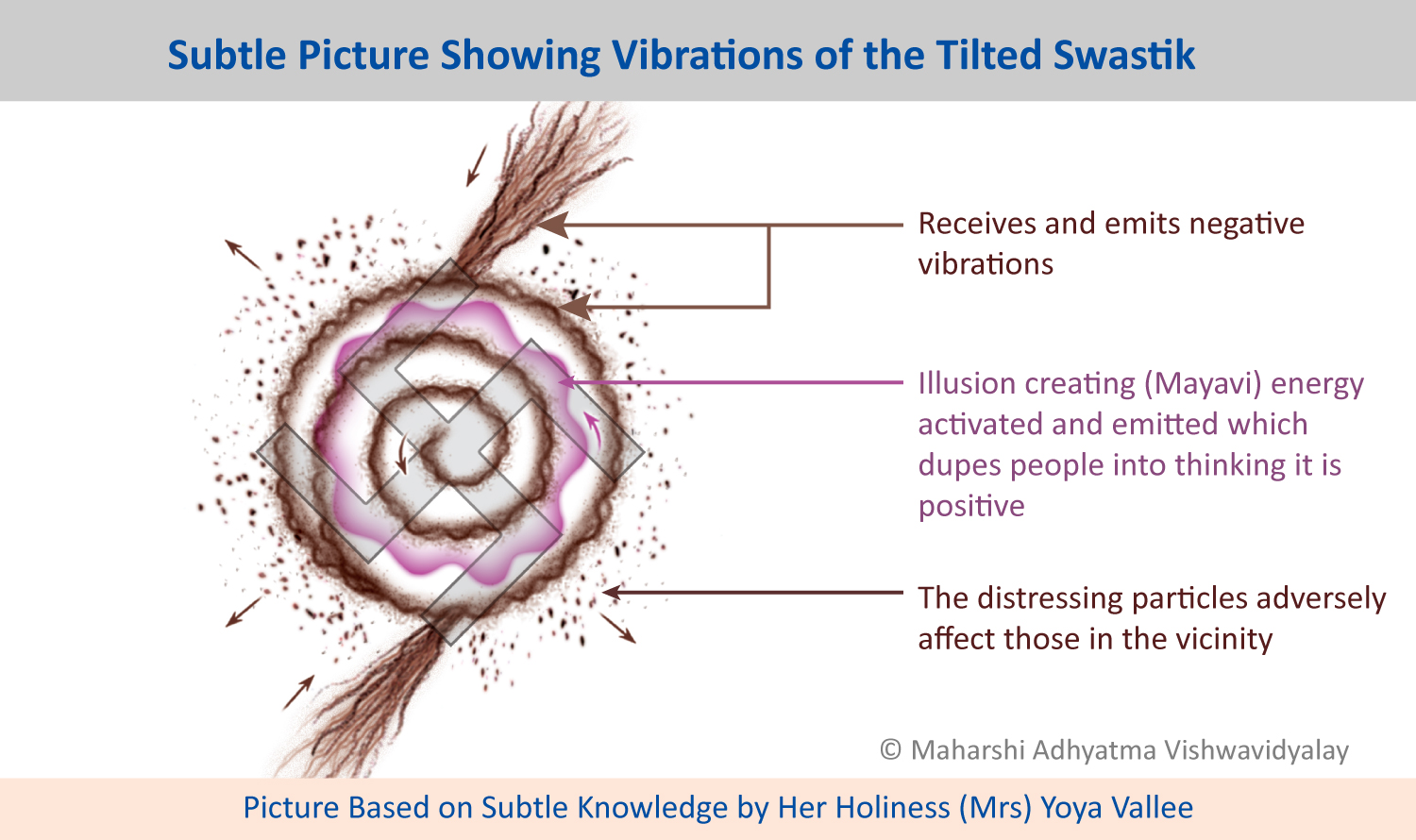
As soon as you tilt it by 45 degrees, as Hitler did, the energy changes completely, and the subtle and distressing energies start to emit from it. Due to the tilt, the Swastik’s ability to attract positive energy is lost.
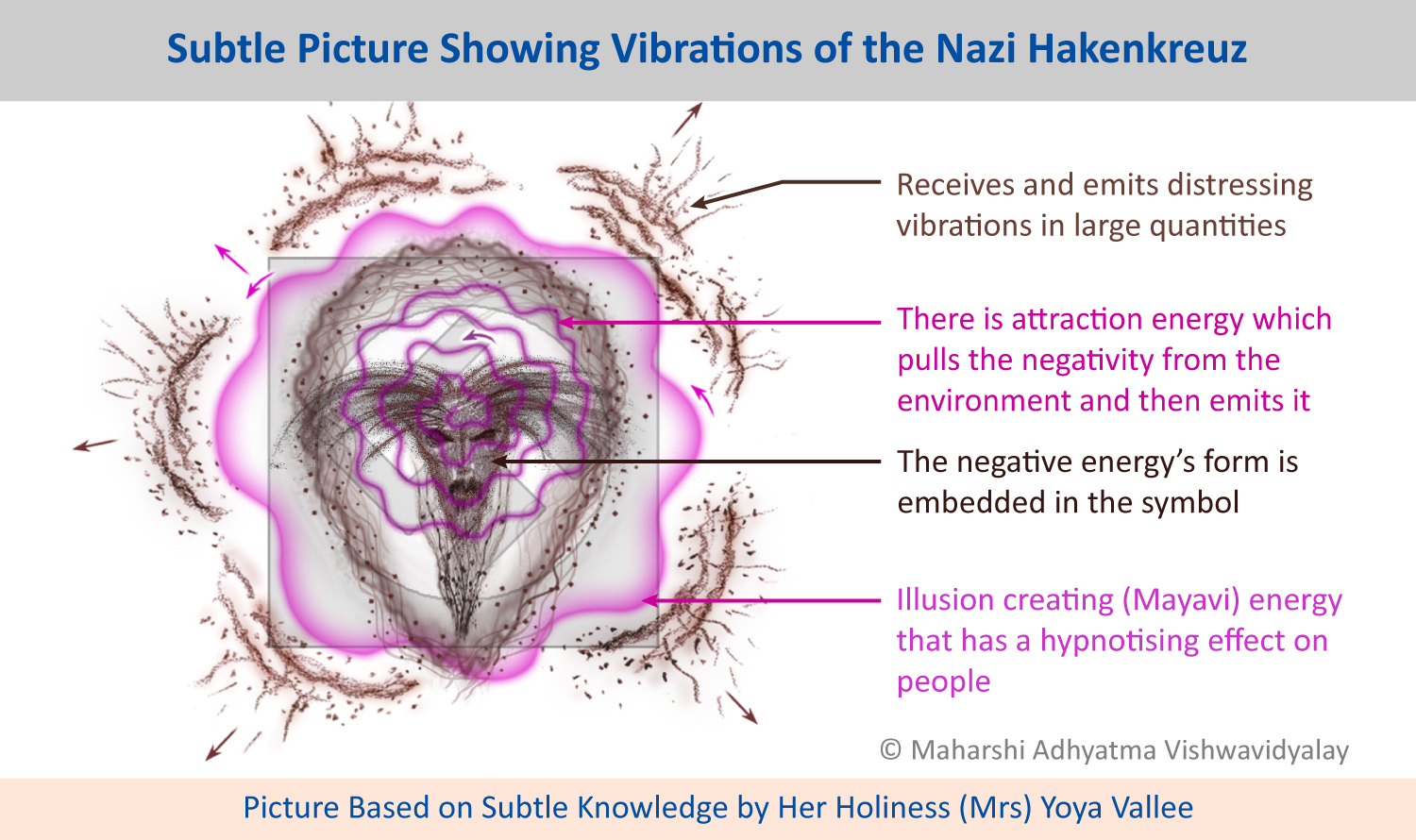
The subtle picture of the Nazi Hakenkreuz reveals an Important detail: the symbol not only emits negative vibrations but also creates an illusory (Mayavi) energy that draws people and further negativity towards it — a quality that helps explain its hypnotic power in Nazi propaganda and mass rallies.
During the Nazi regime, the Hakenkreuz was often worn as an armband. We wanted to study the effect of wearing such symbols on one’s arm.
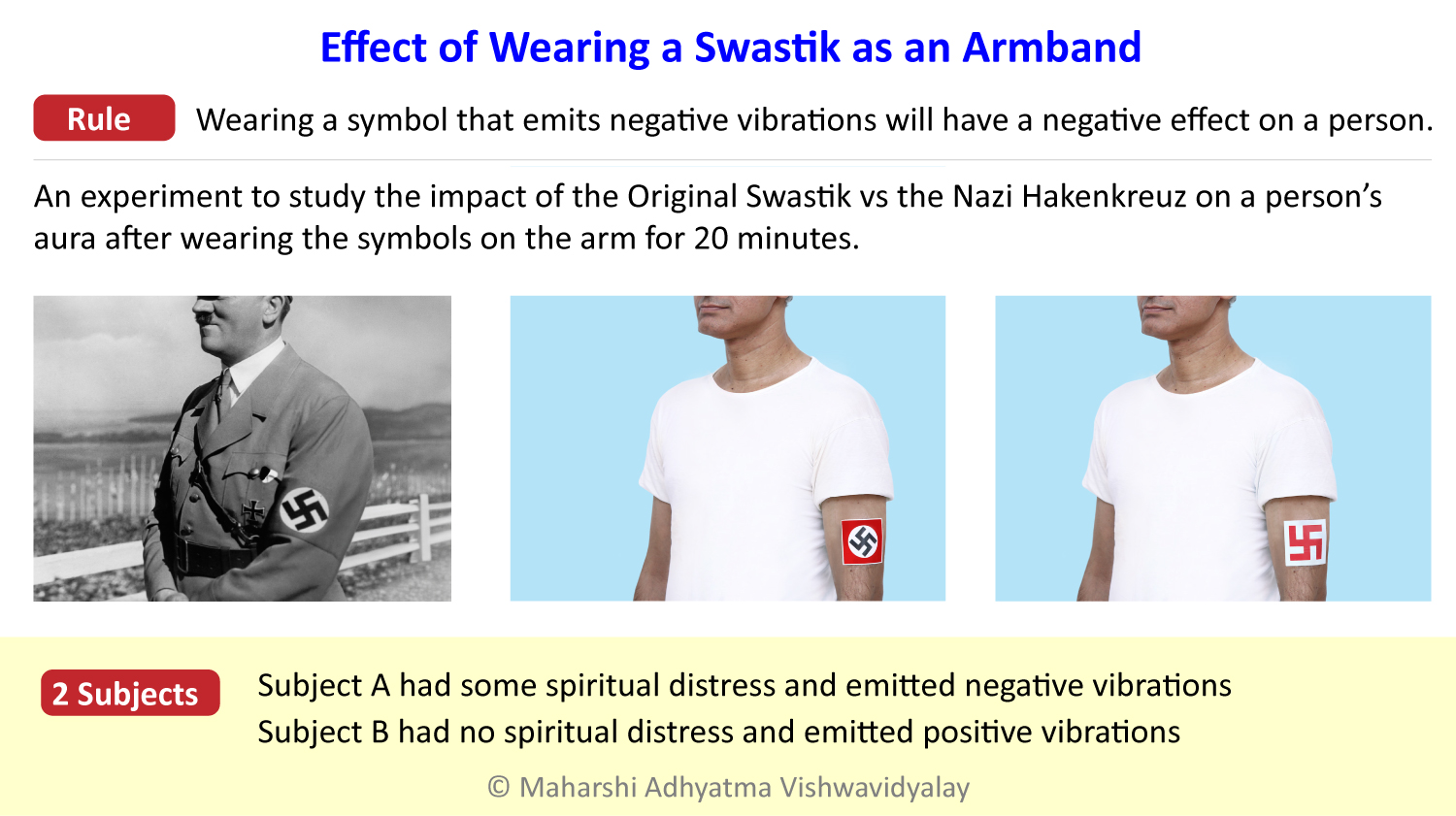
To directly measure the impact of each symbol on the human body, MAV researchers conducted a controlled experiment. Two subjects wore each symbol on their arms for 20 minutes, and, with the UAS, their auras were measured before and after wearing the symbols. The subjects were then allowed to return to their baseline state before the second symbol was applied.
Subject A had some pre-existing spiritual distress and emitted negative vibrations at the outset.
Subject B had no spiritual distress and emitted positive vibrations at the outset.
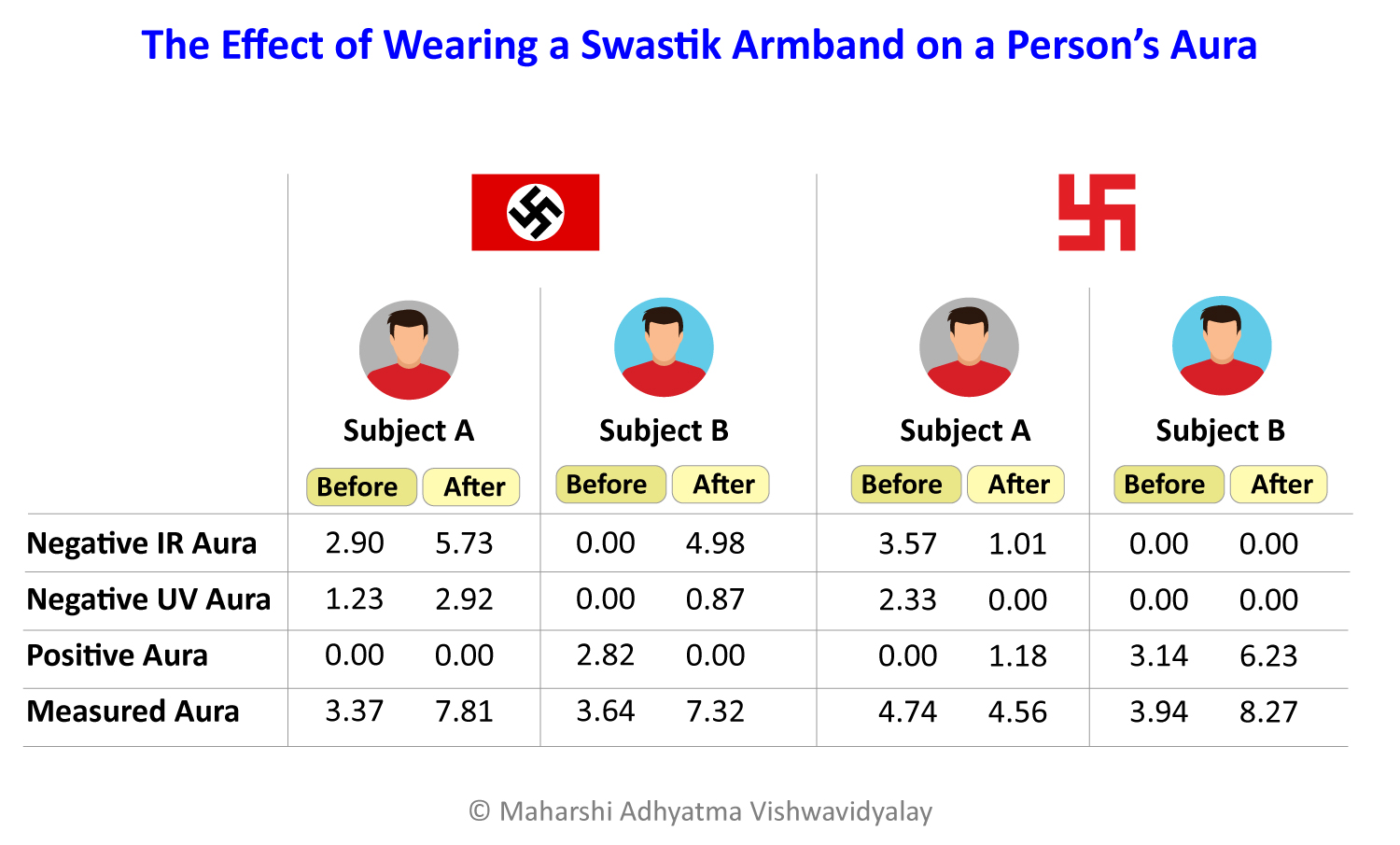
The results are clear. The Nazi Hakenkreuz nearly doubles the wearer’s negative aura and entirely destroys any positive aura present. The original Hindu Swastika does the opposite: it reduces negative aura significantly and generates new positive aura, even in a person already suffering from spiritual distress.
In ancient India, sacred symbols were not created casually.
According to spiritual science:
MAV’s research suggests that preserving the authentic form of sacred symbols is important not only culturally but also spiritually.
Companion Research
The present article focuses on the spiritual significance of the Hindu Swastik using the Maharshi Adhyatma Vishwavidyalay’s methodology, including Universal Aura Scanner measurements, subtle perception and human-subject experiments.
A complementary technical investigation has been independently conducted by the Aura Research Foundation using the Energy Hygiene Framework, the Operator-Mediated Resonance Detection Apparatus (OMRDA) and Energy Flux Pulsator. Readers interested in the frequency-domain characteristics of the various Swastika forms are encouraged to read that companion publication. (Coming soon)