Among musical instruments, the flute is considered the most sattvik because it operates at the level of Ākāsha-tattva (the Ether Principle), the highest of the 5 Absolute Cosmic Principles. But can a flute be designed to express even greater spiritual purity? This question arose during the visit of H.H. Keshav Ginde, a Saint, flautist, and innovator who created a unique 12-hole instrument known as the Keshav flute. Unlike the traditional 6-hole flute, this design aims to enhance the continuity of notes and remove structural limitations.
H.H. Keshav Ginde comes from a deeply musical background. Having learned the flute from childhood, he refined its design over years of dedicated practice. He has performed widely on Doordarshan and All India Radio, given demonstrations in music departments across India and abroad, and written extensively on flute technique and acoustics. His visit to the MAV Ashram created an ideal opportunity to study whether the Keshav flute offers greater spiritual benefit compared to a traditional flute.
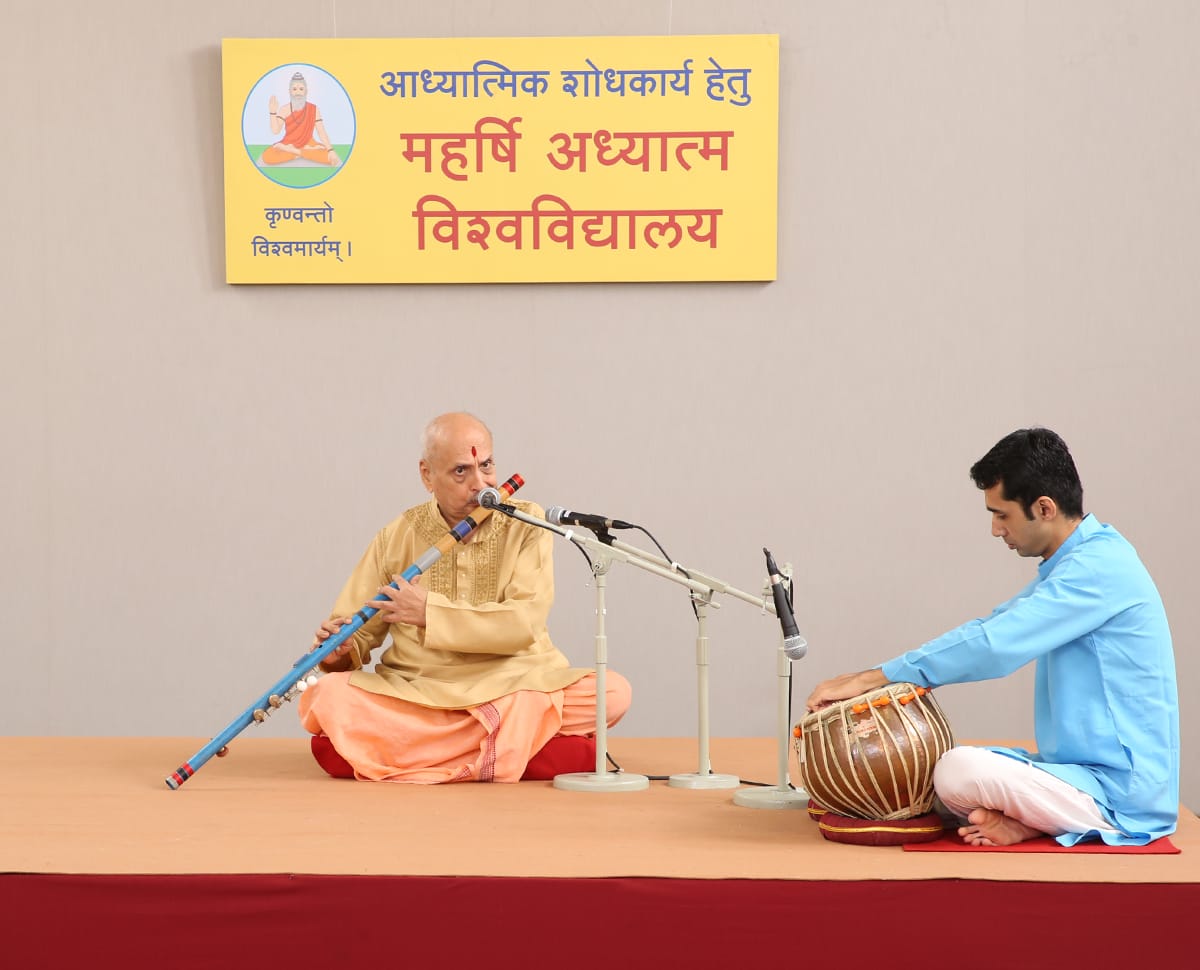
H.H. Keshav Ginde played the traditional flute with a seeker, Girijay Prabhudesai playing the tabla as an accompaniment. There was an audience of seekers, and H.H. Keshav Ginde and another Saint, Sadguru Dr. Mukul Gadgil, attended. Aura readings of the seekers in the audience, the tabla and the traditional flute were taken. As the auras of the 2 Saints in attendance were too large to measure at the venue, photographs of them were taken of them before and after the experiment and readings of their photos were taken at another location.
The next day, H.H. Keshav Ginde played a flute he designed, the Keshav Venu( flute), with Girijay Prabhudesai playing the tabla as an accompaniment. Similarly, aura readings were taken of the seekers in the audience, the tabla and the Keshav Venu (flute). Pictures of the Saints were taken similar to the last experiment and the auras of the photographs from before and after the performance were measured with the UAS.

Both performances showed a clear reduction in negative aura readings among the seekers, with the effect significantly stronger during the Keshav flute performance.
Positive aura readings also increased in both cases, again with greater enhancement during the Keshav flute performance:
A similar trend appeared in the readings of inanimate objects, reinforcing the consistency of the effect.
Why did the Keshav flute offer greater spiritual upliftment? The key lies in continuity between the notes. A traditional 6-hole flute limits the smooth progression between notes, creating breaks in certain ragas (a raga is a melodic framework made up of selected notes and rules that create a distinct musical mood in Indian classical music ). The additional holes in the Keshav flute allow for fluid, seamless transitions between notes, supporting uninterrupted subtle vibrations. This continuous flow appears to enhance the spiritual benefit for both performer and listener. The flute crafted by Keshav features additional holes, enabling the execution of intricate meends (melodic flow of the swaras). This allows the subtle shrutis—the microtonal intervals between notes—to become audible. As Indian classical music is fundamentally shruti-centric, playing all swaras on the flute with these shrutis intact infuses the performance with profound positivity.
These findings illustrate how refinement done with deep study in a musical instrument’s design can elevate its sattvikta and deepen the spiritual benefits it offers.