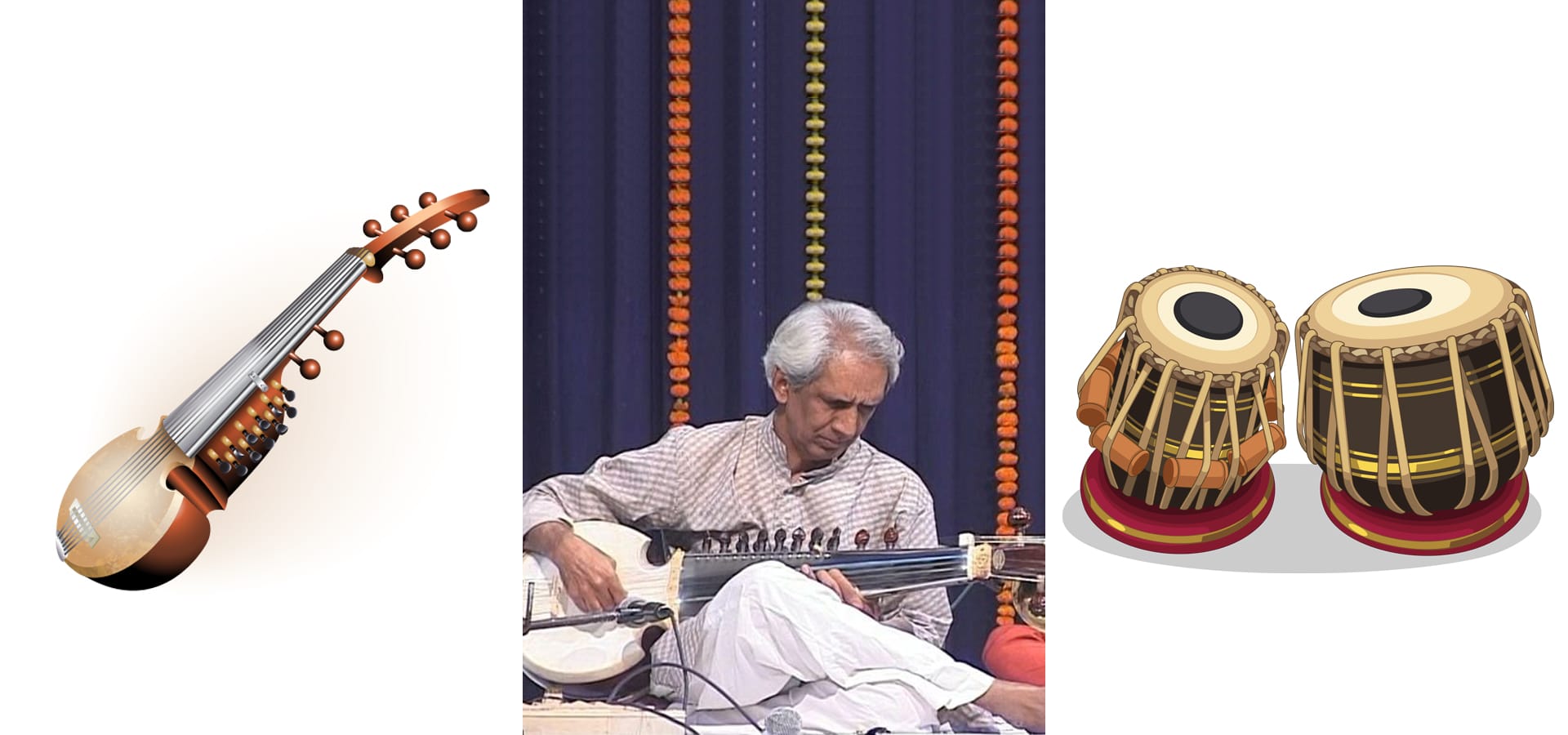

Indian classical music is built on a profound spiritual science. Each rāga is carefully crafted with specific notes, movements, and emotional contours so that both the performer and the listener can experience deeper states of inner positivity. When all the traditional elements of a rāga are honoured, such as its structure, its mood, and its accompaniment, the spiritual benefits increase significantly.
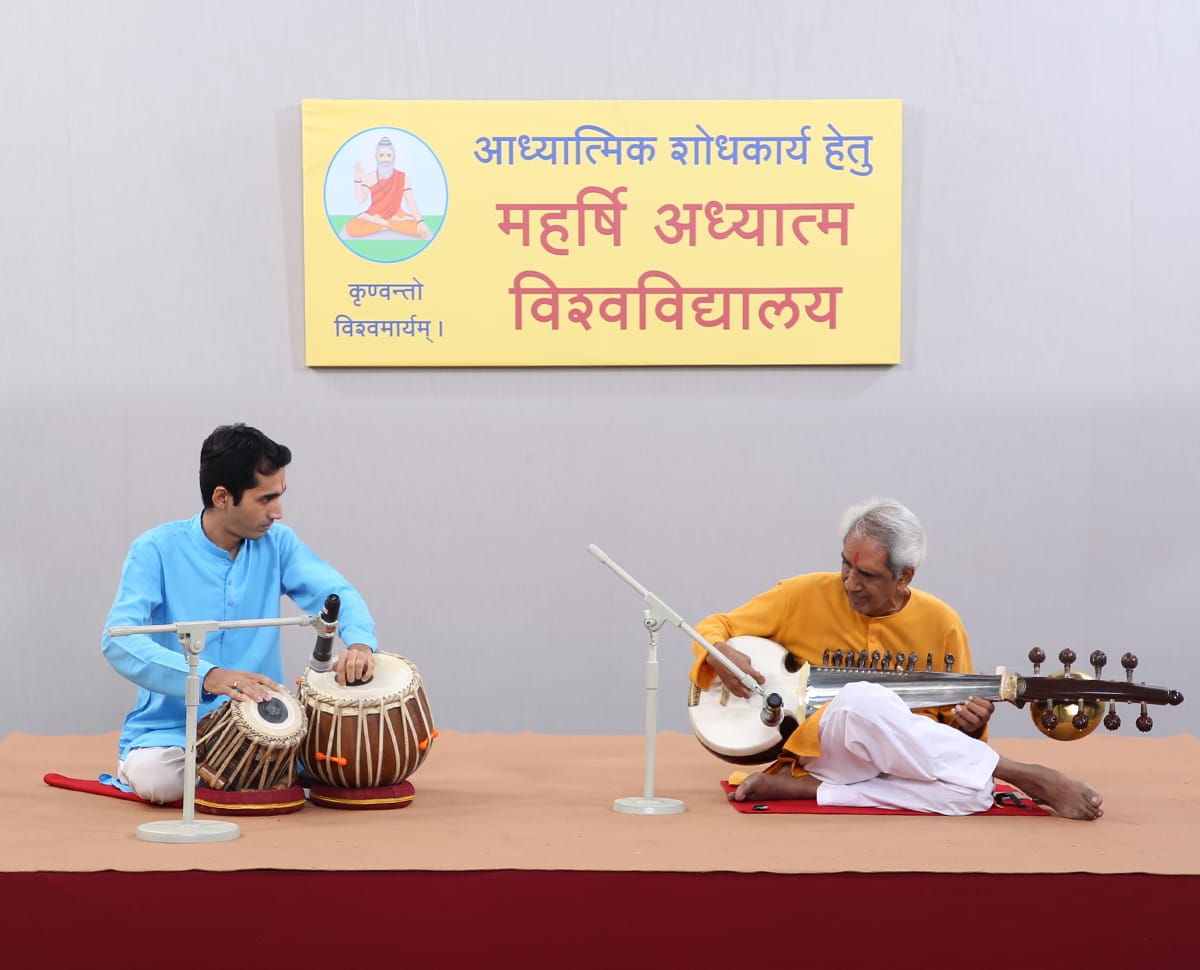
When acclaimed sarod maestro Pandit Pradeep Barot visited the MAV Ashram, it created an ideal opportunity to study this principle in action. Pt. Barot performed Rāg Bhatiyar twice, first on the sarod alone, and then accompanied by tabla player Mr Girijay Prabhudesai , to understand how the presence of the tabla alters the spiritual impact.
Pandit Barot, a Mumbai-based sarod artist with a 65% spiritual level, is a rare blend of musical mastery and deep inner spiritual practice. Known for his humility and devotion, he approaches music as Ishapūjā—an offering to God. Raised in an environment where spirituality and music were inseparable, he learned early that music is not merely an artform but a pathway to the Divine. Even today, he continues to practice the sarod for 4–5 hours a day with the discipline of a seeker, using music as a form of meditation. His life exemplifies how purity, dedication, and spiritual intention can transform music into a powerful tool for inner growth.
Performance 1: Pt. Barot performed Rāg Bhatiyar on the sarod without tabla. Aura readings were taken of the audience, the performer and the sarod before and after the performance using the Universal Aura Scanner (UAS).
Performance 2: Pt. Barot then performed the same rāga with tabla accompaniment. Aura readings were again taken before and after of the audience, the performers (sarod and tabla), and both instruments.
This allowed for a direct comparison of the energetic impact of the two performance formats.

Both performances lowered the negative aura parameters of the audience members, showing that Rāg Bhatiyar itself has a spiritually uplifting effect. However, the presence of the tabla amplified the benefits significantly:
Without tabla: Positive auras increased by an average of 96%
With tabla: Positive auras increased by an average of 190%
This nearly doubled the spiritual upliftment.
Similar results were observed for:
While a sarod-only performance of Rāg Bhatiyar brought clear spiritual upliftment, the addition of the tabla created a dramatically stronger positive impact both for the audience and the performers. This reinforces a core principle of Indian classical music : traditional accompaniments are not just artistic choices but essential elements designed to maximise spiritual benefit.
The study highlights how deeply Indian musical science has been crafted and how, when performed with purity and devotion, music becomes a powerful medium for spiritual transformation.