
In ancient India, many renowned Indian classical singers and musicians were also spiritually evolved. Saint Mirabai, Saint Tukaram, Saint Tulsidas and Saint Purandara Das, to name a few. They sowed the seeds of Bhakti (Devotion) in their listeners through their Bhav (Spiritual Emotion) and Chaitanya (Divine Consciousness). How can today’s Indian classical artists have a similar spiritually uplifting effect on their listeners? The answer lies in their high spiritual level.
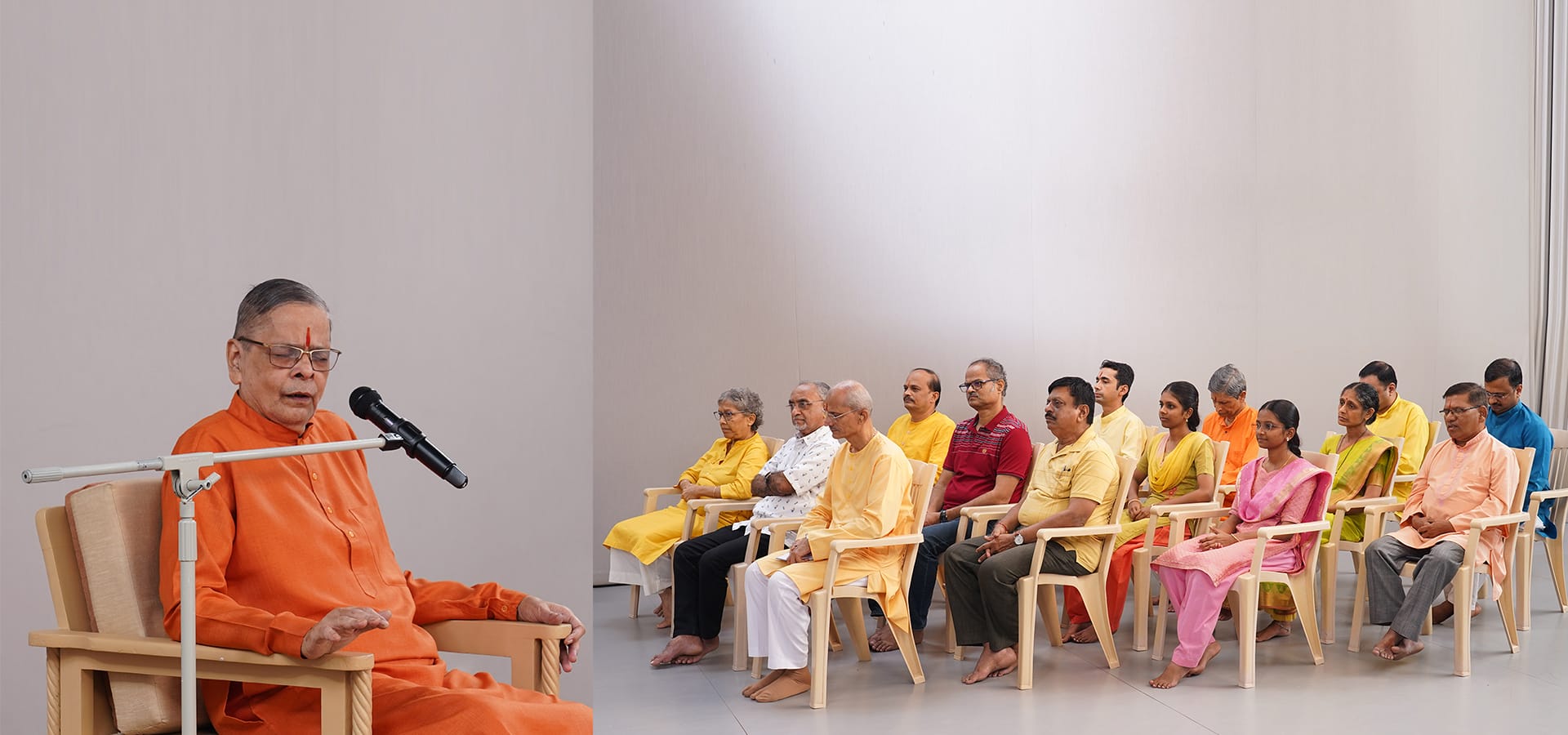
The spiritual research team at MAV was fortunate to have a Saint, His Holiness (Mr) Kiran Phatak, fondly called H.H. Kiran Phatak, from Maharashtra, India, visit the Spiritual Research Centre and the Ashram. He is a renowned Indian Classical singer who has also been bestowed with the title of “Sangeet Alankar”. The research team conducted a few experiments to study the effect of His spiritual level on the audience.
This research was conducted as three successive experiments at the studio of the Spiritual Research Centre and the Ashram at MAV.
In the first experiment, the Saint sang Bandish, a composition in Indian Classical music, in Raga Bhairav. A few participants were selected for the experiment, who were asked to sit and listen to the composition for 20 minutes. The photos of three Deities – Shiva, Krishna, and Ganesha (all created by the seekers of the Arts section at MAV as a part of their spiritual practice) were also placed nearby. Using the Universal Aura Scanner (UAS), the baseline auras and the post-experiment auras of all the objects and subjects, including the Saint Himself, were measured.
In the successive experiment, the Saint chanted “Om Namah Shivaya” verbally (Vaikhari namajapa) for 20 minutes. The objects, subjects, and the aura measurement method remained the same.
In the last experiment, the Saint sat there in a meditative state for 20 minutes. Rest was identical.

Overall, the seekers, the Saint Himself, and the Deities’ photos had higher positive auras after all three experiments. However, interestingly, the seekers without distress seemed to benefit more after listening to Bandish; one seeker with a high spiritual level had an over 80% increase in his positive aura. This was also seen in the case of Deity Shiva’s picture, which showed a dramatic 64% positive increase. Even the Saint’s positive aura increased by 60%.
The seekers with distress seemed to benefit more from the chant “Om Namah Shivaya” chanted by the Saint. In one case, the seeker’s positive aura increased up to 70%. Out of the three Deities’ photos, the maximum increase was seen again in the case of Shiva.
In the third experiment, where the Saint sat in a meditative state, Deity Ganesha’s picture had over 35% positive increment, higher than the other two experiments. Deity Krishna’s photo showed the least positive increase in all three cases. H.H. Kiran Phatak’s aura also increased by 59% in this case, indicating an almost identical effect as when He sang Bandish.
The findings indicate that bandish and chanting attracted Deity Shiva’s Principle (Shiva-tattva), hence, the Principle got attracted to His photo in large amounts, evident from higher positive auras. As the singer was a Saint, there was an overall positive effect on the objects and subjects, which indicates that a Saint influenced His surroundings positively, even when He was not speaking or singing. Why seekers with distress benefited more from chanting and why seekers with no distress benefited more from bandish needs to be studied further.

This study is indicative of the fact that the higher the spiritual level, the higher the positive influence on the surroundings. A performing artist at the level of a Saint can benefit the audience through their Chaitanya, even when they are quiet. They can also attract the Deity-Principle in that particular Deity’s photo in large amounts. Among the Saints, a Paratpar Guru (a Saint above the spiritual level of 90%) will be able to subtly influence their surroundings even more.
The above study is, however, preliminary. More research needs to be done.